When Small Problems
Become Big Failures
Thursday 16th July 2026
The Value of Continuous Partial Discharge Monitoring
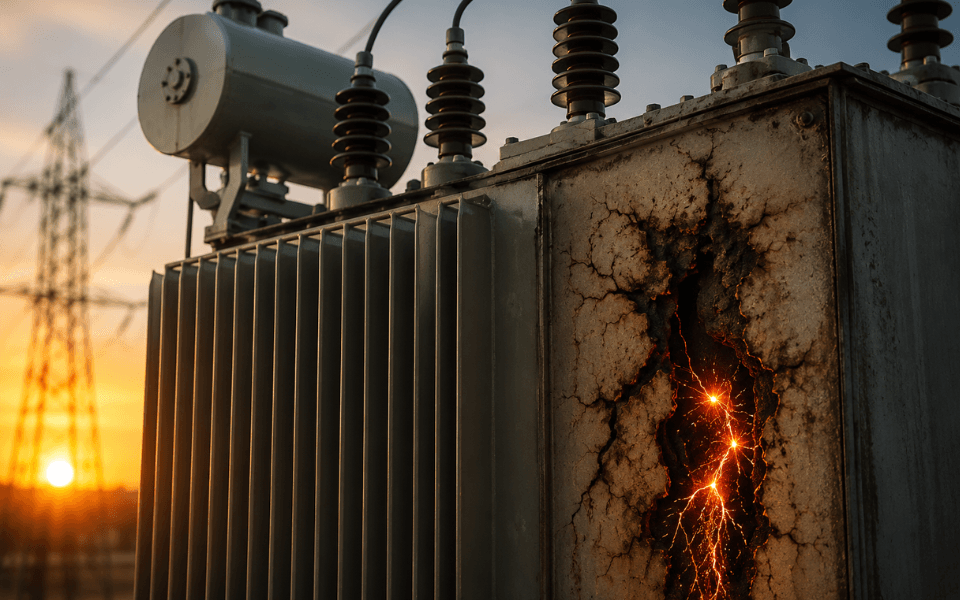
Most catastrophic electrical failures don't begin with dramatic sparks, smoke or a sudden power outage. They start much earlier—with tiny electrical discharges hidden deep within an asset's insulation. These partial discharges (PD) are often invisible to the naked eye and have little immediate impact. Yet over weeks, months or even years, they can gradually weaken insulation until an unexpected failure brings operations to a halt.
These partial discharges (PD) are often invisible to the naked eye and have little immediate impact. Yet over weeks, months or even years, they can gradually weaken insulation until an unexpected failure brings operations to a halt.
The irony is that electrical assets rarely fail without warning. In many cases, the warning signs have been there all along. They’re simply too subtle to detect during day-to-day operation, quietly developing beneath the surface while equipment continues to perform as expected.
By the time a fault becomes obvious, the opportunity for straightforward, cost-effective intervention has often passed. What could have been a planned maintenance activity can quickly escalate into unplanned downtime, costly repairs and operational disruption.
The challenge isn’t that the warning signs don’t exist. It’s that they’re easy to miss.
That’s where continuous partial discharge monitoring comes in.
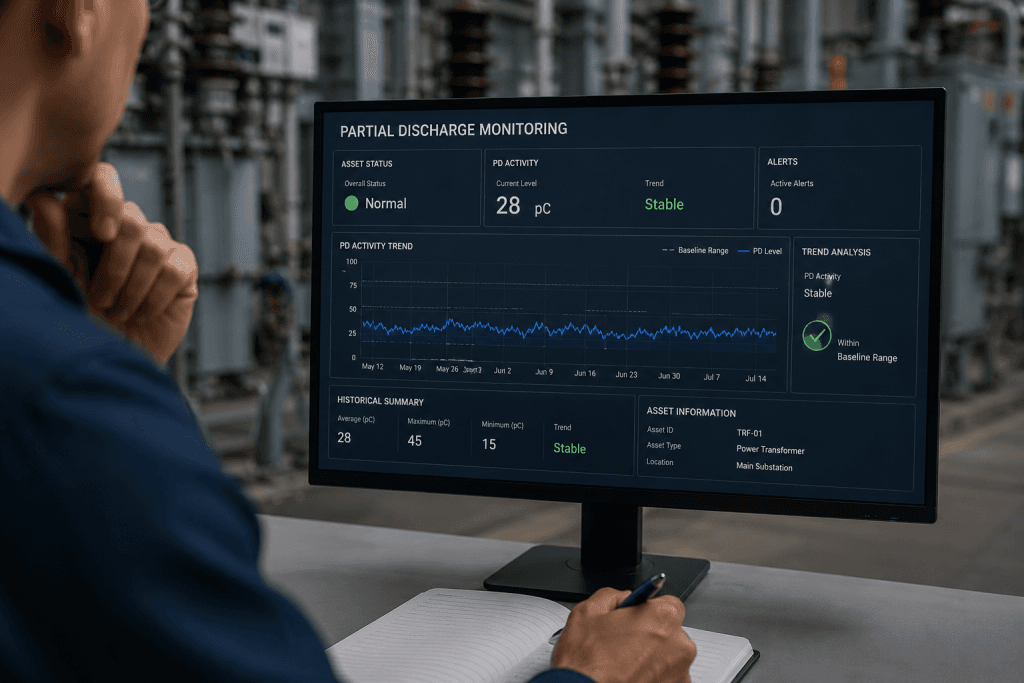
Rather than relying on periodic inspections to provide a snapshot of an asset’s condition, continuous monitoring builds a complete picture over time. By tracking partial discharge activity 24 hours a day, it enables maintenance teams to identify developing insulation defects early, understand how they are evolving and intervene before minor issues become major failures.
The Cost of Missing the Early Warning Signs
Developing insulation defects don’t just threaten equipment—they can affect an entire operation.
Ignoring the early signs of deterioration can lead to:
- Unplanned outages and production downtime
- Emergency repair and replacement costs
- Reduced operational life of critical assets
- Disruption to maintenance schedules
- Increased safety risks
- Higher long-term maintenance expenditure
The earlier a developing defect is identified, the more options maintenance teams have to manage it effectively.

Small Doesn’t Mean Insignificant
One of the biggest misconceptions about electrical asset failure is that it happens suddenly.
We’ve all seen the headlines after a major outage or equipment failure. A transformer trips. A switchboard fails. Production stops. The lights go out. From the outside, it can look as though the equipment failed without warning.
In reality, that’s rarely the case.
Electrical insulation is designed to withstand enormous stresses over many years, but like any material, it ages. Daily operating conditions, temperature fluctuations, vibration, moisture, contamination and electrical stress all contribute to gradual deterioration. These changes are often invisible during normal operation, yet they create the conditions for partial discharge to occur.
Think of it like a tiny leak in a roof. At first, it barely makes a mark. You might notice the odd damp patch after heavy rain, but nothing seems urgent. Over time, however, moisture begins to damage the timber, insulation and plaster. Eventually, what started as a small problem becomes a major repair.
Partial discharge behaves in much the same way.
Each individual discharge is small. In isolation, it may seem insignificant. But every event causes microscopic damage to the insulation surrounding the defect. Thousands—or even millions—of these tiny electrical events gradually erode the material, making the defect larger and the insulation weaker.
The eventual failure may appear sudden, but the damage has often been developing quietly for months or years.
The warning signs were there all along.
What Exactly Is Partial Discharge?
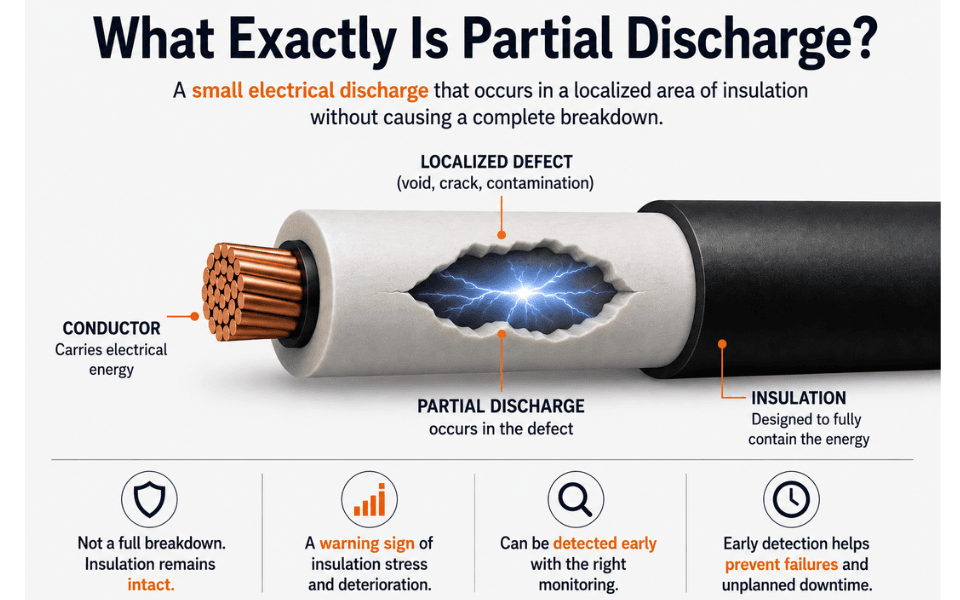
Partial discharge is a localised electrical discharge that occurs when insulation is no longer performing exactly as intended. Instead of electricity remaining fully contained within the insulation system, a small amount of electrical energy jumps across a defect such as an air void, crack or contaminated surface.
Importantly, the discharge doesn’t completely bridge the insulation between conductors. If it did, the result would be a full electrical breakdown rather than partial discharge.
This distinction matters because partial discharge is often an early warning sign—not an immediate failure.
Several factors can contribute to partial discharge activity, including:
- Ageing insulation – Natural deterioration reduces the insulation’s ability to withstand electrical stress.
- Manufacturing defects – Tiny voids or imperfections can become discharge sites over time.
- Moisture ingress – Water reduces insulation performance and encourages electrical activity.
- Surface contamination – Dust, salt or pollution can create conductive paths across insulation.
- Mechanical stress – Vibration, movement and thermal expansion can damage insulation systems.
- Poor installation – Incorrect assembly or cable terminations can introduce defects from day one.
The discharge itself isn’t always the problem. It’s evidence that the insulation system is beginning to deteriorate.
Why Periodic Testing Isn’t Always Enough
Routine partial discharge testing remains an essential part of any effective asset management strategy.
Whether carried out during planned outages or while equipment remains energised, periodic testing provides valuable insight into the condition of electrical assets. It can identify existing defects, establish baseline measurements and confirm whether equipment is suitable to remain in service.
However, every periodic inspection has one unavoidable limitation.
It only tells you what was happening at the moment the test was performed.
Imagine taking a single photograph of a busy motorway and trying to understand traffic patterns across an entire month. The image might show heavy congestion—or an unusually quiet moment—but it can’t tell you how conditions changed before or afterwards.
Electrical assets behave in much the same way.
Partial discharge activity isn’t always constant. It can vary depending on load, temperature, humidity and environmental conditions. Some defects remain stable for years, while others deteriorate rapidly.
Without continuous data, it can be difficult to distinguish between a stable defect and one that’s actively worsening.
Periodic Testing vs Continuous Monitoring
| Periodic Testing | Continuous Monitoring |
|---|---|
| Snapshot of asset condition | Continuous view of asset health |
| Conducted at scheduled intervals | Monitors assets 24/7 |
| May miss developing faults between inspections | Detects changing trends as they occur |
| Useful for identifying existing defects | Useful for understanding deterioration over time |
| Supports routine maintenance | Supports predictive maintenance strategies |
Seeing the Trend, Not Just the Moment
Continuous monitoring fills the gaps between inspections.
Rather than collecting isolated measurements once or twice a year, it builds a detailed picture of how an asset behaves throughout its operational life.
This shift from individual readings to long-term trends is where much of the value lies.
Engineers are rarely interested in a single number on its own. They want to understand whether something is changing.
Has discharge activity increased over the past six months?
Is one phase behaving differently from the others?
Does discharge activity increase during periods of high load?
Is environmental moisture influencing insulation performance?
These questions are difficult—sometimes impossible—to answer from periodic testing alone.
Continuous monitoring provides the context needed to distinguish between a stable defect and one that’s actively deteriorating, allowing maintenance teams to intervene before the issue affects operations.
From Firefighting to Forward Planning
Unexpected electrical failures rarely affect just one piece of equipment.
A transformer, switchgear panel or cable fault can interrupt production, delay projects, affect customers and create significant financial consequences.
Emergency repairs are also the most expensive repairs.
Replacement components often need to be sourced urgently. Specialist engineers are called out at short notice. Planned maintenance schedules are abandoned while teams focus on restoring service.
Continuous monitoring helps organisations move away from this reactive approach.
Early identification of developing insulation defects provides something that’s often in short supply during an electrical failure: time.
Time to investigate. Time to plan. Time to order replacement parts.
Time to schedule work during a planned outage instead of an emergency shutdown. Ultimately, continuous monitoring doesn’t simply detect faults earlier—it enables better maintenance decisions.
Supporting Predictive Maintenance
Maintenance strategies have evolved considerably over recent decades.
Rather than replacing equipment purely because it has reached a certain age, many organisations now adopt condition-based maintenance strategies that rely on real operational data.
Continuous partial discharge monitoring supports this approach by providing ongoing insight into insulation health.
Instead of asking “When was this asset last inspected?”, maintenance teams can ask far more meaningful questions:
Which assets are deteriorating fastest?
Which defects remain stable?
Where should maintenance budgets be prioritised?
Which interventions can safely be postponed?
Which assets require immediate investigation?
This data-driven approach helps organisations improve reliability while making more effective use of maintenance resources and budgets.
Bringing Continuous Monitoring into the Real World
While the principles of continuous partial discharge monitoring are well established, advances in sensing technology are making it easier than ever to deploy permanent monitoring across critical electrical infrastructure.
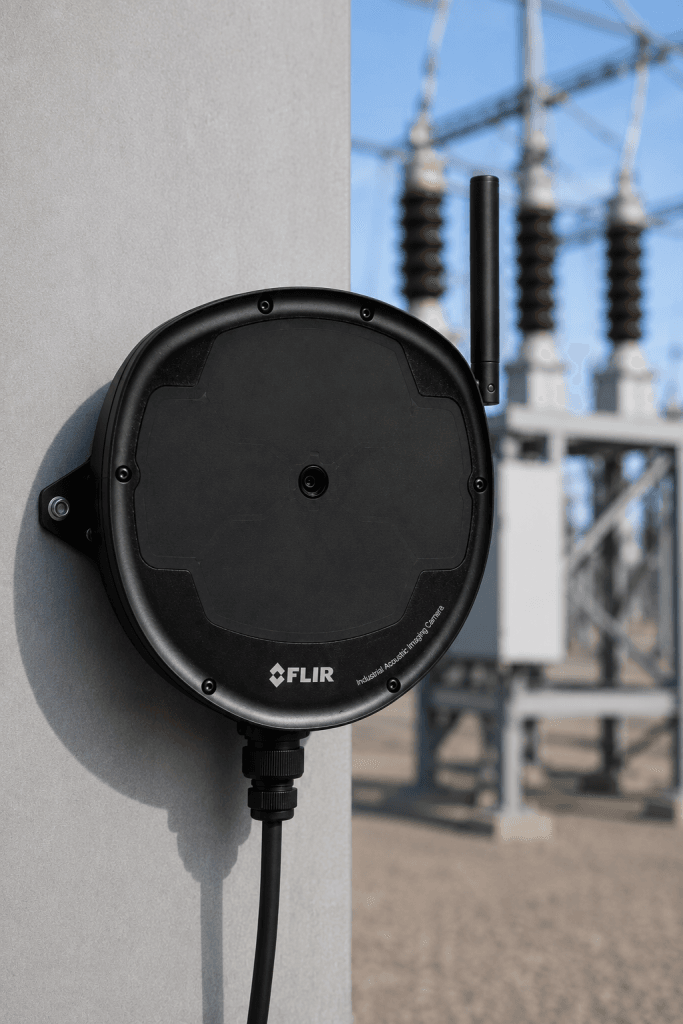
One example is the NEW FLIR Si2a-PD Industrial Fixed Acoustic Imaging Camera, a permanently installed acoustic monitoring solution designed for medium and high-voltage assets. Rather than relying on periodic inspections, it continuously listens for the ultrasonic signatures associated with partial discharge, corona and arcing, helping maintenance teams detect developing insulation defects as they emerge.
Using an array of 124 low-noise MEMS microphones combined with AI-assisted analysis, the camera can automatically detect, locate and classify electrical discharge events. This allows operators to distinguish between different fault types while reducing the need for manual interpretation.
Designed for continuous operation in demanding industrial environments, the Si2a-PD integrates with existing monitoring platforms via REST API, MQTT and other standard industrial protocols. It can be deployed across substations, switchgear, transformers and gas-insulated switchgear (GIS), providing ongoing visibility into asset condition while supporting condition-based and predictive maintenance strategies.
Ultimately, solutions like the FLIR Si2a-PD demonstrate how continuous monitoring is evolving from a specialist maintenance practice into a practical, scalable approach to improving reliability, reducing unplanned downtime and extending asset life.
Not Every Partial Discharge Is an Emergency
Detecting partial discharge doesn’t necessarily mean equipment is about to fail.
Some discharge activity remains relatively stable for extended periods without posing an immediate operational risk. The key is understanding what “normal” looks like for each individual asset and recognising when that behaviour begins to change.
Continuous monitoring establishes this baseline.
By observing long-term trends, maintenance teams can differentiate between stable defects and those requiring intervention.
The objective isn’t to repair every discharge event. It’s to identify changing asset condition before deterioration develops into failure.
Listening Before It’s Too Late
Electrical assets rarely fail without warning.
More often than not, they provide subtle indications that something within the insulation system is changing long before performance is affected. The difficulty is that these warning signs are quiet, gradual and easily overlooked if you’re only checking occasionally.
Continuous partial discharge monitoring ensures those signals don’t go unnoticed.
By transforming isolated measurements into continuous insight, it enables maintenance teams to understand how assets are changing, prioritise interventions more effectively and reduce the likelihood of costly, unplanned failures.
Because the most expensive electrical failures don’t usually begin with sparks or smoke.
They begin with tiny electrical discharges that nobody heard.
Categories
Top Posts
-
Essential Tools for Electricians19 Jul 2024 How To Guides
-
10 Essential Electrical Test Instruments on a Budget09 Feb 2026 Buying Guides
-
Gas Engineers' Guide: Choosing the Right Flue Gas Analyser28 Oct 2025 Buying Guides
-
Choosing the Right Kewtech Multifunction Tester: KT64DL vs KT65DL vs KT66DL26 Jun 2025 Buying Guides
-
Legionnaires' Disease: Causes, Symptoms, Prevention and the Best Legionella Testing Kits14 Jul 2026 Buying Guides
Upcoming Events
More events to be announced…
Newsletter
Sign up to our newsletter for exclusive news, offers, and discounts